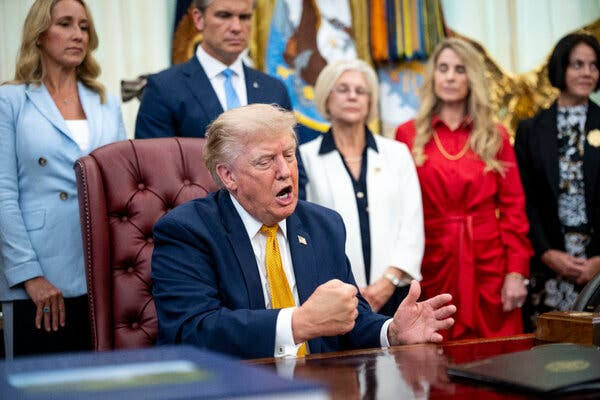
In a White House ceremony on Friday, President Joe Biden presented seven US Army soldiers with the Medal of Honor, the country's highest military decoration for bravery. This was the final time he will serve as commander in chief to preside over such an event.
"To their core heroes, these are real. Different generations, different situations, and distinct ranks of heroes. As he introduced the tales of bravery and gallantry, Biden stated, "But heroes who all went above and beyond the call of duty – heroes who all deserve our nation's highest and oldest military recognition, the Medal of Honor."
Decades after their valiant acts during the Korean and Vietnam Wars, six of the medal recipients received posthumous recognition, and the seventh, then-Private First Class Kenneth J. David, was present at the White House ceremony.
Pvt. Bruno R. Orig, Pfc. Wataru Nakamura, Cpl. Fred B. McGee, Pfc. Charles R. Johnson, Gen. Richard E. Cavazos, and Capt. Hugh R. Nelson Jr. were among those honored posthumously.
"We are presenting these individuals with a Medal of Honor today," Biden stated. "This cannot be our end. It is up to us as a country to make this medal meaningful. to continue the battle. To continue battling for one other, for one another. must continue protecting the causes for which these soldiers fought and for which many of them lost their lives.
In front of an enthusiastic audience on Friday, David shook Biden's hand as he accepted his award.
A sizable enemy force launched a fierce attack on David's company in May 1970. David, a radio-telephone operator, positioned himself to confront the enemy and divert fire from his comrades.
He proceeded "without regard for his own life," according to the White House.
David retaliated with his rifle and hand grenades while he was surrounded on three sides. When enemy forces attempted to attack the injured, he leaped to his feet and shouted to divert attention away from the many casualties his company had sustained.
David continued to battle despite his wounds, deflecting enemy fire from friendly helicopters attempting to land to evacuate other people. He didn't leave his position until the final chopper touched down, and he kept shooting until he was eventually taken down.
Pvt. Bruno R. Orig
In February 1951, Pvt. Bruno R. Orig was returning from a wire-laying assignment close to Chipyong-ni, Korea, when he noticed multiple comrades who had been injured in an enemy assault. He started giving first aid right away and, with the assistance of other soldiers, started moving the injured to safety while coming under enemy fire. On his way back from one of such excursions, he noticed that nearly all of the crew members of a machine gun had been injured.
Orig offered to protect a friendly unit retreating and manned the machine gun. Until they were overrun, he fought there. "Orig was found dead beside his weapon, and the area in front of his gun was littered with several dead enemy soldiers," the White House announced after the lost terrain was eventually retaken.
Pfc. Wataru Nakamura
Gary Takashima, Nakamura's nephew, informed reporters that Nakamura, a Japanese American, was interned with his family following the Pearl Harbor assault. He nevertheless joined the Army "as soon as he could," according to Takashima, "to demonstrate his devotion and sense of duty to his country." He was called up from the Reserves during the Korean War after serving in Europe during World War II.
While inspecting and fixing a communications wire between his unit and a command post, Nakamura was assaulted and killed in severe fighting in May 1951. When Nakamura checked the communications connection and saw that enemy forces had "surrounded friendly positions and were threatening to break the company defense lines," he was shot at, according to the White House.
According to the White House, Nakamura drove the enemy out of multiple seized bunkers by rushing them with a fixed bayonet and destroying a hostile machine-gun nest. When he ran out of ammunition, he pulled back, but before he was killed by an enemy grenade, he rearmed and rejoined the battle alongside other soldiers.
Last Monday, Nakamura's family told reporters, "He would have felt that all of this was too much for doing what he was supposed to do, but he would have been greatly honored to receive the Medal of Honor."
Cpl. Fred B. McGee
Following the wounding of several of his fellow soldiers, including his squad leader, McGee took command of his squad and "delivered a heavy volume of supporting fire" during an assault on an enemy position in June 1952. McGee shifted his gun multiple times under heavy fire to support the attack while providing cover fire to other platoon members. He gave the order for his team to leave their position, but they refused to comply, remaining behind to remove the dead and injured.
According to the White House, He was injured in the face, yet he courageously endangered himself by trying to evacuate the company runner's body while standing upright under intense enemy mortar and machine-gun fire.
His granddaughter, Kristen Lee Bailey, told reporters last week that McGee passed away on January 3, 2020, and that his actions on the battlefield were "not surprising, as he was always selfless, loving, and honorable in everything he did."
Pfc. Charles R. Johnson
In June 1953, Chinese forces launched a massive nighttime attack on Johnson's bunker, killing him. Despite his injuries, Johnson helped fellow soldiers and killed multiple enemy soldiers in hand-to-hand battle while providing first aid to others. After arriving in the shelter of a second bunker, Johnson declared that the situation was "untenable" and positioned himself between the German forces and the injured, promising to keep them at bay "as best as he could."
According to the White House, his valiant and unselfish actions saved the lives of up to ten men.
Johnson's nephew Garry Trey Mendez never had the opportunity to meet his uncle. However, he has met the guys Johnson rescued and heard their tale of bravery.
He informed reporters Hearing his story told to the nation as a whole is simply amazing, and we hope it will inspire everyone as much as it has inspired our family over the years.
Gen. Richard E. Cavazos
Cavazos served as a first lieutenant in the Korean War, leading his company in a June 1953 raid on a heavily fortified enemy position, some thirty years before he was appointed the first Hispanic four-star general in the history of the US Army. Cavazos and his men were under heavy fire after they had caused significant casualties on the outpost. After withdrawing and regrouping, Cavazos—for whom the expansive Texas military installation that had been known as Fort Hood would later be renamed—led additional assaults on the enemy stronghold, eliminating enemy people and equipment each time.
Cavazos was told to leave the battlefield, but he kept going back to pick up and evacuate the casualties who had been left behind. He only let himself get medical attention for his injuries when he was certain that the hill had been cleared. Cavazos spent 33 years in the service.
He climbed the hill that night in 1953 to gather his company's soldiers and get them to safety because of his unselfish love. Cavazos' son Tommy told reporters last week that his father was a devout man who loved his nation, his family, and his soldiers.
Capt. Hugh R. Nelson Jr.
During the Vietnam War, in June 1966, Nelson was serving as the aircraft commander of an armed Huey helicopter when it was shot down and crashed in the center of enemy positions. Nelson started removing his team from the wreckage, removing two men from the aircraft as enemy fire approached from a distance of roughly thirty feet. According to the White House, he covered his buddy with his own body after placing the second soldier on the ground, using it "as a human shield."
The White House stated, "He sacrificed his own life to save the life of his fellow soldier." Then, one of Nelson's comrades managed to signal other planes to evacuate the survivors and Nelson's body using a smoke grenade.