
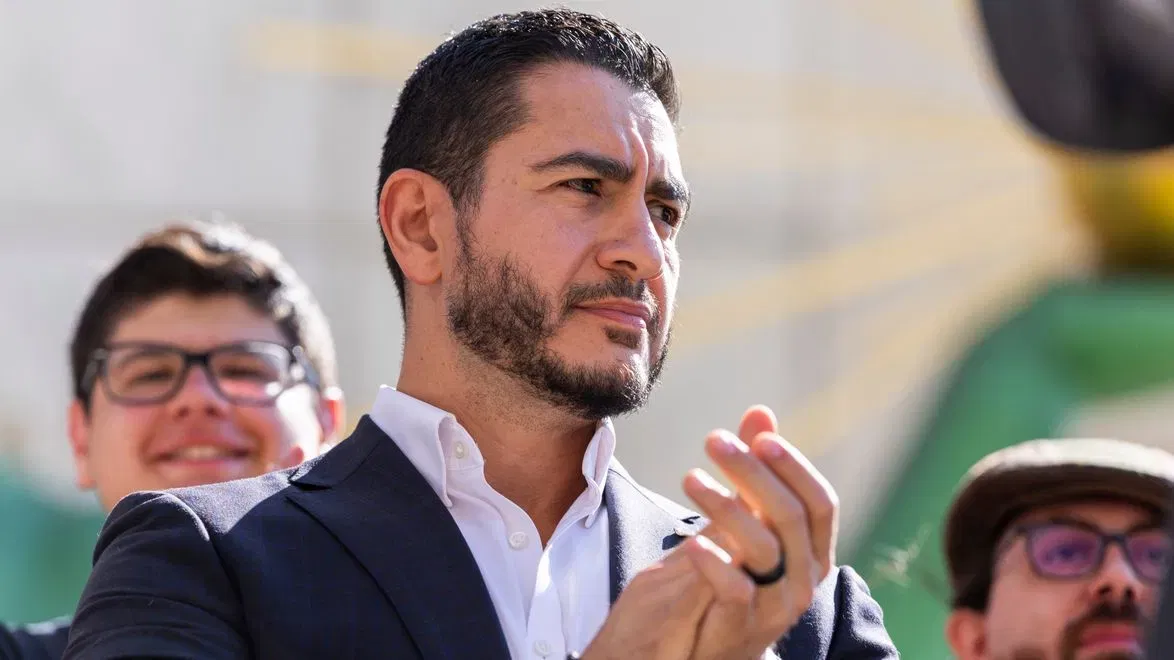
The Democratic establishment's concerns that Michigan Senate nominee Abdul El-Sayed would jeopardize its chances of gaining the majority in the chamber were validated by a recent survey conducted last week.
According to the Fox News poll, his personal image was 13 points worse among registered voters, with 42% favorable and 55% unfavorable. In a head-to-head contest, he was just marginally behind his GOP opponent.
El-Sayed is the party's exception, despite the fact that his possible drag on the Democratic ticket has drawn a lot of attention.
In reality, in some crucial elections, Republican candidates are the ones that struggle with popularity.
According to recent polling averages, Sen. Susan Collins and state Attorney General Ken Paxton are both 12 points underwater in Maine and Texas, meaning that more people have negative opinions of those Republicans than positive ones. El-Sayed's position in the Fox poll is comparable to that.
The GOP standard-bearer has a net-positive average image rating in just one of the eight races that are most likely to decide the Senate majority, Alaska, while all Democratic candidates—aside from El-Sayed—are in positive territory.
Additionally, the Democratic nominee is more popular by eight to twenty-four points in seven of those eight contests.
The largest disparities occur in Georgia and Iowa, where state senator Josh Turek and senator Jon Ossoff, the Democratic nominees, both do well in polling. On average, each of their positive evaluations is at least 20 points higher than their negative ones. (In Turek's case, he is less well-known, but it doesn't appear that many people don't like him.)
Reps. Mike Collins and Ashley Hinson, their GOP rivals, have mediocre personal image ratings.
Additionally, Democrats have a significant advantage in Texas, where state representative James Talarico is 5 points ahead of Paxton, who is 12 points—a difference of 17 points.
Troy Jackson, a Democrat and former state Senate president of Maine, is plus-3, with a 15-point difference in his personal image ratings. Collins is a Republican competing in a state that leans blue, so her minus-12 net image rating would seem to be a serious issue. (Politicians who win in states that are not conducive to their cause typically enjoy widespread popularity.)
Notably, in a Fox poll conducted in Maine, roughly the same percentage of registered voters expressed "extreme" or "very" anxiety that Collins sided with President Donald Trump too frequently (55%) as they expressed "extreme" or "very" concern that El-Sayed's issue viewpoints are too extreme (54%) in a Fox poll conducted in Michigan.
In North Carolina, former Republican National Committee Chairman Michael Whatley is 15 points behind Democratic former Governor Roy Cooper, who is 14 points ahead.
In Ohio, appointed Republican Sen. Jon Husted is five points underwater and Democratic former Sen. Sherrod Brown is four points above water, creating a nine-point difference.
In Alaska, GOP Senator Dan Sullivan's plus-1 image rating is eight points higher than that of Democratic former Representative Mary Peltola, who is plus-9.
Furthermore, El-Sayed is not the only unpopular person in Michigan. Mike Rogers, a Republican former member of Congress, is likewise, albeit less so (minus-6 in the Fox survey).
The Republican nominee's image is five points negative and the Democratic nominee's is eight points positive on average across the eight states. And Michigan is part of that.
How much that reflects the national context vs the candidates themselves is a major topic. Voters' obvious dissatisfaction with Trump may trickle down to Republicans like Susan Collins, who are perceived as his supporters.
However, that only goes so far in explaining things. Even though the Democratic Party is currently nearly as unpopular as the Republican Party, people seem to like its nominees in some important contests. That implies some strong recruiting and, in Talarico's and Turek's cases, guiding their candidates through difficult primaries.
Given how difficult this year's map is for the party, it's feasible that Democrats will need El-Sayed to win in order to have a chance at the Senate majority. And that's a major factor in the controversy surrounding his nomination.
However, it's undoubtedly not the complete picture of the Senate race.

.png)
