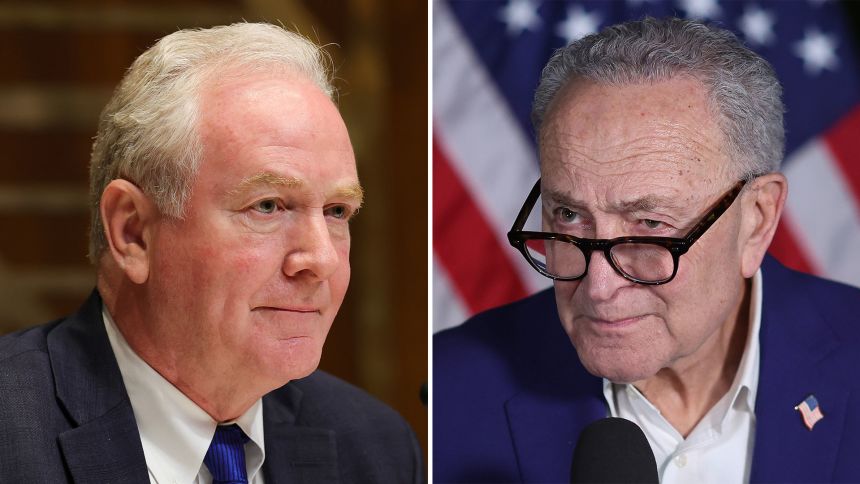
The torch-passing moment that many activists long for is barely evident in a Democratic leadership contest between a 70-something Chuck and a 60-something Chris.
However, "generational change" is a relative concept in the US Senate.
However, Sen. Chris Van Hollen of Maryland's challenge to Sen. Chuck Schumer's leadership of the Democratic majority in the Senate next year is more important than it may appear. First of all, it implies that the extent of the Democratic victory is already altering the party.
"On election day, we witnessed a massive explosion of democracy. Van Hollen stated on MS Now, "Red states, blue states, purple states," contending that the outcome went beyond a backlash against Trump. "In reality, the call was to reject business as usual and the existing quo. And I believe we need fresh leadership to accomplish that.
In what is already beginning to seem like a fierce battle with President Donald Trump over his last two years in office, the role of leading 55 and possibly 56 Democratic senators next year will be critical.
Additionally, this goes beyond a Beltway popularity contest. It shows a party still figuring out what to do with their startlingly wide midterm election victory. Conflicts over philosophy, strategy, policy, and the disappointed hopes of Democratic rising stars will be highlighted in the contest. These conflicts grew more intense after the election resulted in a governing coalition that is far more geographically and intellectually diverse than anybody anticipated. Additionally, it indicates that a recurring theme in the run-up to the 2028 election will be disputes between the party's Washington officials and its base.
New York senator Schumer, who has served five terms, is a clear favorite and said he is certain he will win the leadership contest on December 1. However, Schumer will now face a leadership contest that might cast doubt on his authority even if he prevails, in contrast to his Republican counterpart, current Majority Leader John Thune, who was quickly returned to lead his party despite the GOP defeat.
Progressives and some of the more recent members of the incoming Democratic minority have turned to Van Hollen as an unexpected conduit for their desire for more active leadership, or at the very least, to encourage Schumer to adopt a more assertive stance. A confrontation between Van Hollen and Schumer will also expose the party's division over Israel. While Schumer has long been one of the Democratic Party's most vocal backers of the Israeli government, the Maryland senator has strongly condemned Israel's war in Gaza.
"I like Chuck."
Sen. Elissa Slotkin, a moderate pragmatic from Michigan, and progressive icon Bernie Sanders had a joint Capitol Hill press conference earlier this week, which increased the likelihood of a leadership confrontation.
"I enjoy Chuck. No one puts in more effort than Chuck Schumer. Sanders, an independent from Vermont who votes with Democrats, stated, "But in my opinion, the time is now for change and I will not be supporting Chuck to be reelected as the Democratic leader." "We need a new generation of leadership... Senator Sanders and I disagree on some items, but we agree on the need for change," Slotkin continued.
Senate authority is accumulated over several years. However, the chamber's clubby customs do not apply to a bold new group of Democrats elected in an anti-Trump backlash. For ten years, Schumer has guided Senate Democrats through periods of control and minority. He's hardly an avatar of change by definition. Additionally, a lot of activists think that throughout the first two years of Trump's second administration, he was too docile. When a group of Democrats joined Republicans in voting to end a government shutdown without obtaining their demands for an extension of expanded Affordable Care Act subsidies, he was accused of treason.
The Senate's most progressive Democrats now see the huge victory in the midterm elections as an opportunity to fight for much more comprehensive reforms.
"I have nothing to take away from Senator Schumer. Sen.-elect Abdul El-Sayed of Michigan told CNN's Kaitlan Collins on Tuesday, "He's worked very hard to help architect the majority that we will enjoy in the next two years." However, I do believe that a different style of leadership is required at this time. When my state stood out, they demanded Medicare for All, money out of politics, and money in your pocket. They desired action.
As a progressive, El-Sayed could not find much justification for defending the party's establishment. He defeated Rep. Haley Stevens, who was thought by Washington leaders to be the most likely candidate to win in November, in a fierce primary. He is now supporting Van Hollen.
As a typical New Yorker, Schumer is viewed by some as being unrepresentative of the new majority's geographic reach, which will include new senators from historically red states including Texas, South Carolina, Mississippi, North Carolina, and Iowa. These politicians competed not just against Trump but also against the leadership of their own party and the cultural stances of leftists. Therefore, they have no motivation to vote for Schumer as their first action in Washington.
Following the election, Scott Colom, the newly elected senator from Mississippi, told Jen Psaki on MS NOW that it was not ideal that Schumer and Hakeem Jeffries, the likely next Democratic speaker, "live in the same borough." "Too many of our leaders are from the same parts of the country," he continued. I'm looking for someone who is familiar with rural America, our beliefs, and our needs.
Colom is right. However, Congress is a slow-moving institution. In the Senate, whose senators are appointed to six-year terms, this is particularly true. It seems sense to move a member of the fresh intake directly into a leadership position. Democrats who were already in line, however, would object. Nonetheless, the party must figure out how to take into account the cultural and ideological preferences of the freshman who won its big majorities if it is to be successful.
"Give him a new contract."
A talent for tallying votes is the most crucial attribute for a Senate leader. Additionally, Schumer openly declared that he had them in an effort to quell any potential Democratic uprising.
"I am certain that I will be chosen as majority leader. Additionally, our caucus is genuinely united in its goal on reducing expenses, eradicating corruption, putting an end to disorder, and ending the war. Our caucus is incredibly united," Schumer stated on Tuesday. He reiterated his claim that he had the votes on Thursday nite and invited a contest of ideas.
He might be absolutely correct. Senators will be able to publicly express their opinions while secretly voting for the Democratic leadership, but their decision will ultimately be made at the polls. Senators might thus pretend to oppose the establishment while providing guarantees of support in private.
Another unwanted turn in Schumer's lengthy career is the leadership contest. Speculation about his potential retirement has already been stoked by the prospect of leftist Representative Alexandria Ocasio-Cortez challenging him in the 2028 primary.
Some Democrats, particularly those who have been in office for some time, contend that it would be unjust and foolish to remove Schumer as leader. Sen. Ruben Gallego of Arizona stated this week, "You give him another contract when the manager takes you to the World Series."
Kirsten Gillibrand, a fellow senator from Empire State, stated that Schumer ought to receive recognition for assembling a stellar group of candidates and collecting hundreds of millions of dollars to support them. "You will see, despite all the complaints, a great deal of gratitude for the hard work he has done to get us to this position," she remarked. Gillibrand also bluntly mentioned that she and Schumer participated in a Colom event a year prior.
With its unbreakable codes, the Senate chamber is hardly a place for beginners. The Democrats' reputation for self-sabotage would only be reinforced by a fierce internal conflict at a time when the party has finally regained control.
Additionally, certain requests for change might just not be possible to fulfill. Democrats would still face Trump's veto even if they broke Senate tradition by doing away with the filibuster, which needs 60 votes for the majority of significant legislation. A lengthy strategy that puts them in a position to regain the White House and hold onto their legislative majorities in 2028 might be their best option.
However, that won't satisfy outspoken calls for quick change.
Schumer's reappointment as Senate majority leader is therefore highly likely. However, calls for new leadership may become unavoidable after 2028.