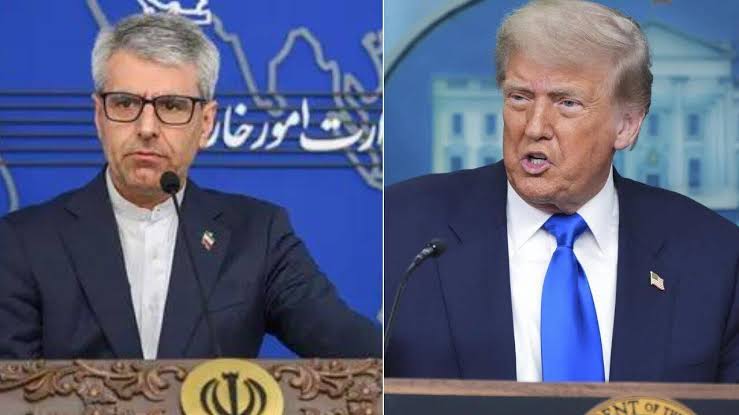
Access to the president's daily intelligence brief has been severely curtailed by the Trump administration.

Five people familiar with the situation told CNN that the Trump administration has severely limited who may view President Donald Trump's highly classified daily intelligence report.
From the beginning of Trump's second term, administration officials intended to restrict access to the so-called President's Daily Brief, or PDB. This was partly because, during his first term, the president believed that the intelligence community was working against him because details from the report were occasionally leaked to the media.
According to one of the individuals, White House Chief of Staff Susie Wiles was initially personally approving who was allowed access. The document is currently under the supervision of Tulsi Gabbard, who was sworn in as Trump's director of national intelligence in February and has assumed accountability for determining who gets access to it.
New administrations frequently change who has access to the PDB. Additionally, professional intelligence officials who are in charge of assembling it usually approach a new administration to inquire about who should be given access to it, and authorities frequently take initial steps to restrict access.
However, Trump has had a strong disdain of the intelligence community since he was elected president in 2016, and he has appointed personnel in his second administration who publicly express this mistrust. According to current and former officials, the president and his top officials are determined to suppress leaks and bring down what they perceive to be subversive elements within the intelligence community. This underscores what one US official called "ongoing large distrust issues."
This mistrust, which culminated in Trump's belief that the FBI's probe into his 2016 campaign's connections to Russia was a politically driven "witch hunt" and a "hoax," still permeates the administration's tough handling of the intelligence community.
In particular, Gabbard has made public promises to "clean house" and "aggressively [pursue] recent leakers." "I will welcome dissenting voices to be able to make sure that [the PDB] is thoroughly vetted prior to presenting it and make sure that the truth is reported whether that truth is convenient or not," she told senators during her confirmation hearing.
"There was bipartisan agreement that the PDB needed significant reform during DNI Gabbard's confirmation process," a spokesman told CNN in a statement. "To guarantee President Trump has the most up-to-date and accurate information to safeguard the American people, the Director is dedicated to modernizing a number of antiquated procedures."
Reducing access to the PDB, according to former officials familiar with the process, is a hesitant step that could increase governmental divisions and result in a disjointed foreign policy, but it could also help to boost confidence between the president and the community.
According to a former intelligence officer, "if you limit it too much, you're not operating off the same page and you have disagreement in the administration on key issues." "You don't have (Secretary of State Marco) Rubio doing the same thing (special envoy to the Middle East Steve) Witkoff is doing," according to a hypothetical statement.
The White House has been contacted by CNN for comment.
"Too many" people were receiving the PDB.
Although the PDB has been around since the Kennedy administration in one form or another and has been presented in various formats under various presidents, it is generally considered to be one of the most significant documents produced by the US government and contains some of its most sensitive and current analysis.
Although there has been a fluctuation from president to president, the overall trend over the past few decades has been to increase diffusion. One former intelligence official claims that Richard Nixon, for instance, had a very, very small dissemination list and once prohibited his own defense secretary from viewing it.
According to one former official, "there are slimmed-down versions that are appropriate for most, but very few need what POTUS gets." Other former officials maintain that "way too many people" were receiving the PDB under Presidents Biden and Obama.
According to one of the sources, at least one suggestion for revamping the PDB that was shared among top Trump officials in the early days of his administration advocated for limiting access to the PDB to a small number of extremely senior people and capping it at about ten pieces per day.
Some agencies have been able to renegotiate access, according to one of the sources.
obtaining it has prestige, according to a number of previous officials; even if they don't have a clear "need to know" basis for obtaining the paper, nobody like being left out.
The former official stated, "Everyone wants to be a cool kid and get all the good stuff, to get what the president gets just so they can be part of the club."
Senior officials may nonetheless obtain the intelligence contained in the PDB in some way even if they do not receive it.
However, according to this individual and another former intelligence official, the White House runs the possibility of a chaotic situation where senior officials get marginally differing analytical interpretations of US intelligence if access to the PDB is restricted too much.
They may react inconsistently to advances in foreign policy because they won't be working from the operating picture.
For instance, that may disfavor the US in delicate negotiations, as Trump is presently doing with several US enemies.
Already, various Trump administration officials in charge of US foreign policy appear to be publicly expressing slightly different opinions about the administration's strategy. This is especially true when it comes to tariffs, where White House trade adviser Peter Navarro has expressed the strategy differently than Treasury Secretary Scott Bessent and National Economic Council Director Kevin Hassett.
It is important to consider access to the PDB: By reducing it, the president can feel more assured that the intelligence analysis will remain confidential and, perhaps, be able to take into account the analysts' candid opinions without being distracted by the politics of the matter at hand.
However, it can also conceal from important individuals in charge of implementing his programs the best judgments the US has on its enemies and the threats they represent to the nation.
"In theory, I don't think it's bad because it will give the intelligence community more freedom because they won't be under as much pressure to keep things secret. They'll be able to tell POTUS if he's not worried that Tom, Dick, and Harry are reading it and it might leak," the former official stated.
However, the PDB "provides a baseline for the entire national security team, so it's critical that everyone understands the fundamentals of what's happening," the individual stated.
enduring mistrust
Since Trump was elected president in 2017 and senior Obama administration officials first informed him of the intelligence community's conclusion that Russia had attempted to meddle in the 2016 election on his behalf, there has been a persistent mistrust between him and the vast intelligence community he currently leads.
Trump seemed to learn that the intelligence community was attempting to use its data and analysis as a weapon to discredit his administration during his first administration, when leaks, especially of classified material, were common.
According to the source, Trump's top advisors made an effort to similarly address PDB concerns during his first term by holding a closed-door briefing known as the Oval Office Intelligence briefing.
According to one of the individuals, Trump declined to accept intelligence briefings that are customarily provided to major party candidates prior to the 2024 election, partly because to PDB material leaks during his first administration.
He has made a concerted effort in his second term to restrict access to intelligence and policy discussions to a select few people who the White House believes are sufficiently committed to the MAGA cause.
Current and former U.S. officials say that dynamic is especially intense at the CIA. According to current and former officials, the White House recently stepped in to remove a longstanding career official who had been appointed to head the agency's operations division. This is an unusual move, as the agency typically chooses who gets that position.
According to the US official, "things are very tightly held with innermost circle."