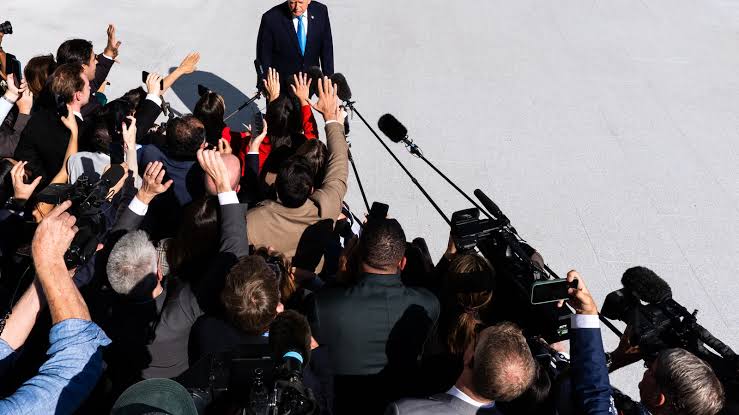
President Donald Trump has launched an intensive campaign tour through heavily Republican states as his party prepares for the November midterm elections, with GOP candidates facing increasingly competitive races in places that have traditionally been considered safe for Republicans.
Trump's visit to Grand Island, Nebraska, on Monday was part of a broader campaign strategy that has taken him through states he won comfortably in the 2024 presidential election. The tour is aimed at energizing Republican voters and boosting candidates in races where party officials are concerned about turnout and voter dissatisfaction.
Trump Campaigns in Deep-Red Nebraska
Trump's Nebraska visit focused on Republican Senator Pete Ricketts, who is seeking another term against independent candidate Dan Osborn.
Nebraska remains strongly Republican at the statewide level, but the Senate contest has attracted national attention because Osborn is mounting a stronger challenge than Republicans had expected.
Trump won Nebraska by more than 20 percentage points in 2024, but his campaign stop highlighted the concern among Republicans that strong presidential support does not necessarily guarantee high turnout in a midterm election.
Trump held his rally in Grand Island, located in Nebraska's heavily Republican 3rd Congressional District. He has not scheduled comparable stops in the state's more competitive congressional districts, including the Omaha-area 2nd District.
Economy Becomes a Major Concern
Economic issues are emerging as a central concern for voters in Nebraska and other Republican-leaning states.
High fuel prices have become particularly important in agricultural communities during the harvest season. Local reporting cited by CNN described concerns among farmers over diesel costs, fertilizer prices and broader household expenses.
Trump attempted to address those concerns during his Nebraska visit by signing an executive order aimed at expanding tax-free use of red-dyed diesel, which is commonly used for agricultural and other off-road purposes.
The White House said the move was intended to reduce fuel costs and ultimately lower expenses for consumers.
Beef Imports Create Another Challenge
Trump's decision to allow additional imports of foreign beef has also become a contentious issue in Nebraska, one of the country's major cattle-producing states.
The administration has argued that increased imports could help reduce grocery prices. Some Nebraska ranchers, however, have criticized the policy because they fear additional foreign beef could put pressure on domestic producers.
Ricketts has also expressed opposition to the beef-import policy, making the issue particularly relevant to his reelection campaign.
The debate reflects a broader tension between Trump's effort to reduce consumer costs and concerns among agricultural producers about the effect of imports on their businesses.
GOP Concerns Extend Beyond Nebraska
The Nebraska race is part of a broader pattern that has drawn Trump's attention to traditionally Republican territory.
His recent campaign schedule has included Texas, Oklahoma, Alabama and Ohio, with additional appearances planned in Republican-leaning states.
CNN reported that one Republican member of Congress described the political situation as a “five-alarm fire,” expressing concern about voter sentiment in states Trump won comfortably. The lawmaker spoke anonymously to avoid conflict with the White House.
The concern is not necessarily that these states are becoming Democratic strongholds. Instead, Republicans are focused on whether economic dissatisfaction and lower enthusiasm could reduce turnout or make normally safe races more competitive.
Trump Tries to Turn Election Into a Choice
At his recent rallies, Trump has sought to frame the midterms as a choice between his administration's policies and those of Democrats.
He has warned supporters that Democratic victories could bring severe economic consequences and has repeatedly urged Republicans to vote.
Trump has also acknowledged the historical difficulty presidents face during midterm elections. At a recent Alabama appearance, he said presidents generally perform poorly in midterms regardless of whether they are Republicans or Democrats.
That history is an important part of the current political environment. In Trump's first term, Republicans lost control of the House in the 2018 midterms while expanding their Senate majority.
Republicans Focus on Turnout
The president's travel schedule suggests that Republican turnout is a major priority in the final weeks before the election.
Rather than concentrating exclusively on closely divided states, Trump is spending substantial campaign time in areas where he can draw large crowds and directly encourage Republican supporters to participate.
CNN reported that White House officials are using the president's appearances to motivate voters in heavily Republican areas and reinforce support for candidates such as Ricketts.
The strategy comes as Democrats are also targeting Republican-held seats that they believe could become competitive.
With the November election approaching, both parties are increasingly focused not only on persuading undecided voters but also on ensuring their existing supporters actually turn out.
For Trump and Republican candidates, the challenge is whether the president's campaign appearances can translate strong rally enthusiasm into votes while voters remain concerned about fuel prices, grocery costs, foreign policy and other issues.


.png)