Trump claims that if negotiations show success, additional assaults on Iran are "highly unlikely."
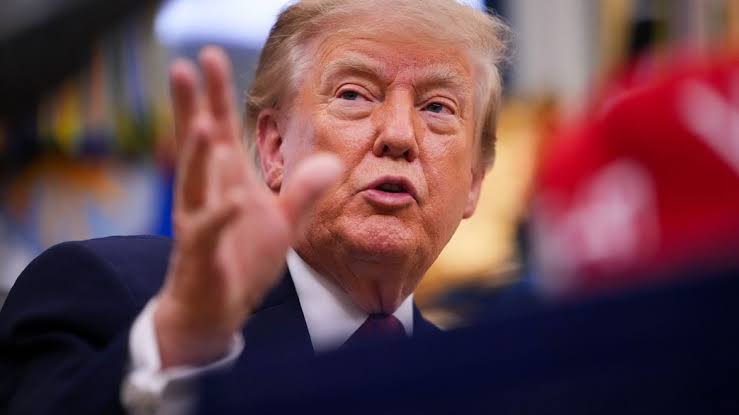
In an interview with CNN on Sunday, President Donald Trump reiterated five times that it is "highly unlikely" he will have to order the United States to go back to war with Iran as long as negotiations over Tehran's nuclear program and reopening the Strait of Hormuz continue.
In a 20-minute phone conversation with CNN's Jim Sciutto, Trump said of Iran, "It depends on whether or not they sign a very strong agreement." It is quite improbable that the response will be required. They are a collapsing country. You just learned that inflation was 301% this year. Very improbable that it will be required. We hit them hard, but I would if needed. I struck them so hard. You have no idea how hard I struck them.
He then on, "So it's highly unlikely I'll have to." "Their finances are deteriorating. We've used force against them. We could eliminate them.
"We're prepared for it."
Iranian attacks on oil tankers traveling through the Strait of Hormuz have left the two sides at a standstill eight months after the war began, with little military action and little diplomatic advancement.
Regarding the state of their negotiations, neither the two nations nor representatives from Qatar, which has mediated the talks, have spoken out. However, Iranian hardliners have interpreted the results of last week's midterm elections, which were partly influenced by the unpopularity of the war among US voters, as evidence of a weakened Trump administration that would be more amenable to their nation's demands to be permitted to continue its nuclear program, which it claims is necessary for energy, and to keep control of the strait.
Under US sanctions, Iran has also had difficulty selling crude oil on international markets, and assets worth billions of dollars kept in foreign institutions have been frozen.
In the meantime, the US military has started offering a reward of up to $20 million for information on Iran's nuclear program and has established a task force to prevent Tehran from moving advanced weapons and other materials via land routes. These actions indicate that Washington is applying more pressure rather than lessening it.
During the conversation, Trump—who has previously given conflicting signals regarding his intentions to stop the war—made it apparent that US forces are positioned in the area in case he gives the order to strike. "We're prepared for it. Three aircraft carriers are with me. The other one just showed up. There are three of us. They're loaded and completely locked," he remarked.
The president added that in the event of fresh military action, the US has designated infrastructure targets within Iran, such as bridges and power facilities. He declared, "We have 38 bridges on our site that we can demolish in literally one hour." "Everyone will be down."
He did, however, state that he would rather not damage Iranian infrastructure. He stated, "I don't want to do that because it will basically take ten years to rebuild them." "I dislike tearing down bridges. And building a bridge is the most difficult task. I'm a skilled builder, but it takes years.
Since the midterm elections on Tuesday, there has been an uptick in diplomatic activity around the Middle East.
A day earlier, Iran's Foreign Minister Abbas Araghchi had a conversation with his counterparts from Saudi Arabia, the United Arab Emirates, Oman, Pakistan, Kuwait, Jordan, Turkey, Cyprus, and Qatar. On Friday, Qatar reported that Trump had called Qatari Emir Sheik Tamim bin Hamad Al Thani to discuss de-escalation.
Secretary of State Marco Rubio stated that a resolution in the negotiations did not seem close before departing on Sunday for the G7 foreign ministers conference in Paris.
He told reporters in Florida, "I wouldn't say we're on the verge of a breakthrough." "As of right now, it hasn't been very productive because the Iranian demands are not only unacceptable, but in some cases, outrageous, ridiculous, and really not realistic."
Iran's depleted reserves
Trump said that Iran's air defenses have been destroyed, making it impossible for Iran to fend off more US assaults. Because they lack antiaircraft equipment, it is unstoppable. He declared, "All of their antiaircraft is gone."
The president also gave fresh information about Iran's drone and missile stockpiles, stating that the country still has 15% of its drone capabilities and 10% of its missile capacity.
"They are only able to produce some drones and missiles at a 10% level. Due to the loss of several of their factories, drones are at roughly 15%, he said.
Regarding the possibility of more military action, he reiterated, "Most likely it will not be necessary." "They are desperate to reach an agreement."