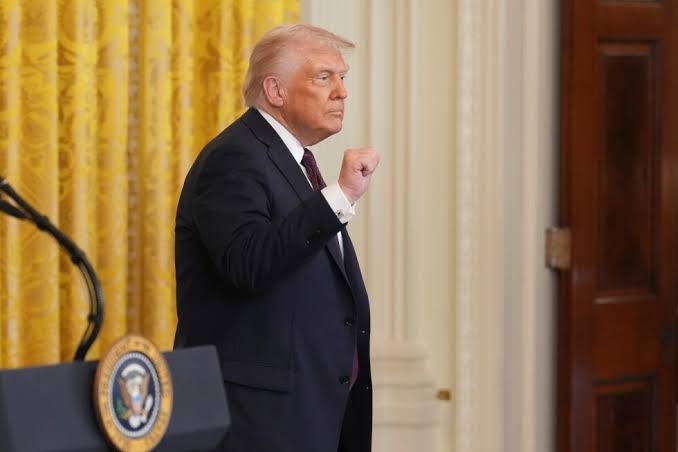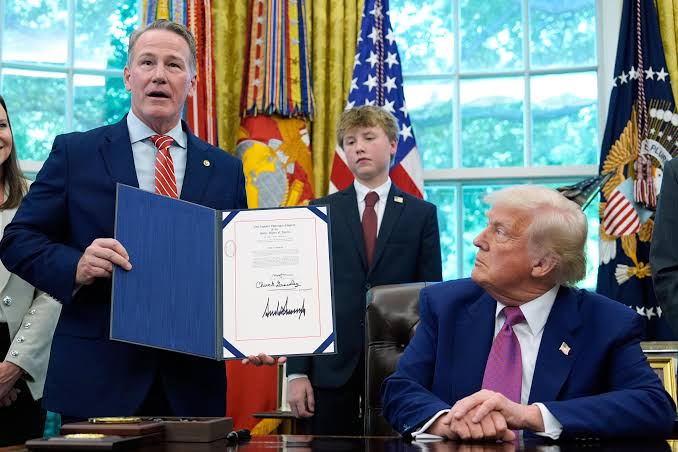
With a boisterous rally in Ohio, where Republicans are vying for a Senate seat that could be crucial to the majority, President Donald Trump began a week of red-state campaigning on Monday.
In order to appease his supporters and deliver red meat political assaults, he railed at Somali and Haitian communities for parts of his roughly ninety-minute speech. He occasionally referred to two out-of-state Democrats, Minnesota Representative Ilhan Omar and Michigan Senate contender Abdul El-Sayed, as more formidable opponents than former Ohio Senator Sherrod Brown, who is challenging GOP Senator Jon Husted in a state that Trump has transformed into a consistently red stronghold.
Following Ohio, Trump is expected to visit Alaska and Montana, where he won by 13 and 20 points, respectively, in 2024. His campaign is counting on him to boost base turnout in conservative regions. However, a sizable portion of the seats on the left and right of the press riser, which provided good views of the president, were empty on Monday nite when Trump returned to the same stadium where he performed a crowded "thank you" tour in 2017.
Despite two major disruptions, it was a far livelier event than previous prior rallies. A protester sporting a "Release The Epstein Files" t-shirt and a rallygoer in the stands looked to get into a fight at one point. A young woman carrying a Mexican flag interrupted once more.
Trump's argument focused heavily on immigration, reiterating a point he made in 2024 when he falsely claimed that Haitian immigrants in Springfield, Ohio, were consuming their neighbors' pets.
He prepared to attack Omar, a frequent target of his wrath, by saying, "Just look at what's happening in the once great state of Minnesota."
A Justice Department official and a source familiar with the situation said that early on Monday, federal officers carried out a search warrant at the congresswoman's residence in the Washington, DC, region.
Trump continued to refer to Omar, a US citizen, as a "disaster" and disparage the nation where she was born, despite his insistence that he had nothing to do with the search.
"[Rep. Omar] comes into our country and says, 'I have a constitutional right.' She comes from a country without laws, without police, without military, without—all they do is shoot each other,'" Trump remarked. "Is she entitled to a constitutional right? She is from one of the worst nations on earth, yet she is discussing the Constitution with us.
"Deport!" was chanted by audience members as he embarked into a diatribe against Somalis in the United States.
At one point, Trump repeated his remark about "low IQ people," saying, "They think they're in Somalia, where they don't have pants to wear."
He used Minnesota, a blue state, as the antithesis. "We will prevent Ohio from being pillaged, looted, and devastated in the same way that Minnesota has been." We're going to put an end to it, just as we did with Springfield," Trump declared.
The president attempted to more broadly associate the former three-term incumbent with national Democrats when he turned to Brown, who leads Husted by six points in CNN polling released last week.
In addition to wanting the Midwest "turned into Mogadishu," Trump declared, "Sherrod Brown is the candidate of the Marxists, the communists, the anti-American radicals, who want to tear down America's heritage."
First elected to the Senate in 2006, Brown is a progressive populist who maintained his position during Trump's first term in 2018 but lost reelection in 2024 while running alongside Trump.
Trump reiterated his request that voters "pretend" he is running this year, saying, "So, what happens is every time I run, we do great."
According to data released by the secretary of state's office last week, the first days of early voting in Ohio revealed indications that Democrats are more eager to cast ballots, with affiliated Democrats making up higher shares of pre-election voters than they did two years ago, even in the most Republican areas of the state. (However, Republicans have been far more likely to cast ballots early in person or on election day in recent years.)
Trump claimed that a vote for the former senator may have far wider repercussions, seemingly acknowledging Ohioans' prior propensity to support Brown.
It's just one vote, but it has the power to move Congress in a direction you won't like. It's also not Ohio values.