Reagan and Gorbachev's nuclear statements are echoed by Trump, Putin, and Xi, but will their deeds follow suit?
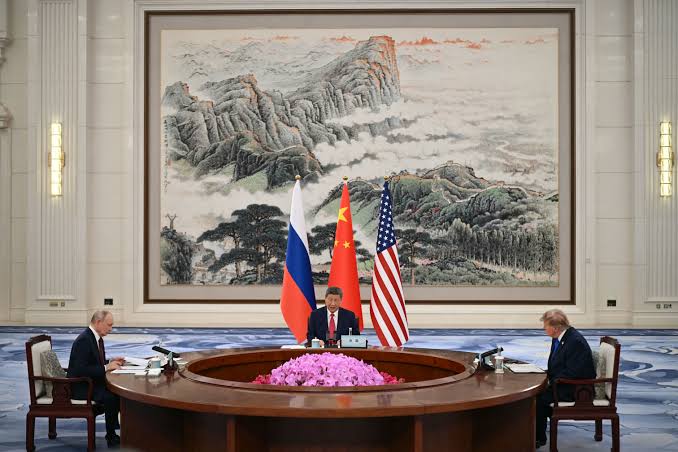
There may not have been any immediate diplomatic success from last week's historic three-way summit between Russian President Vladimir Putin, Chinese President Xi Jinping, and US President Donald Trump.
However, one of the leaders' joint statement's sentences, "a nuclear war cannot be won and must never be fought," has its own historical significance.
The term was first used by former President Ronald Reagan in a speech to the country in 1982. It became significant in 1985 when Reagan and Soviet leader Mikhail Gorbachev included it in a joint statement following a Geneva summit. The comment "was a catalyst that Gorbachev grabbed onto," according to Allan Myer, a National Security Council employee who joined Reagan's speechwriting team after leaving the Army, as he recalled to CNN.
In later decades, the term gained a "life of its own" and was dubbed the Reagan-Gorbachev concept, according to Myer.
Declassified records reveal that the two Cold War leaders carried the notion into their October 1986 summit in Reykjavik, Iceland, when they promised to dismantle their respective nuclear arsenals before the negotiations collapsed due to a disagreement over missile defense.
In the years that followed, the US and the Soviet Union/Russia signed two arms control agreements that eliminated a class of nuclear weapons and required a mutual reduction in the number of larger nuclear weapons, despite the summit's seeming failure at the time.
Charles Oppenheimer, the grandson of J., the man who invented the atomic bomb. In an interview with CNN, Robert Oppenheimer cited this historical pattern and expressed his hope that the "human connection" that the three world leaders developed during this week's conference will foreshadow future legislative initiatives aimed at lowering the threat of nuclear war.
Oppenheimer highlighted "how much of a failure (Reykjavik) seemed at the time" during a recent ceremony honoring the 40th anniversary of the Reagan-Gorbachev summit.
Oppenheimer contended, "But we kind of know with historical hindsight... that led on to the most productive period of arms control."
The reaffirmation of the motto that guided the 1986 meeting, according to filmmaker Michael Russell Gunn, who wrote, directed, and produced The Brink of War, a drama based on the Reykjavik negotiations, offers a sign of "hope" following the recent expiration of the Cold War-era arms control agreements.
Nuclear risk reduction specialists are less hopeful that a breakthrough is imminent this time. This week's trilateral conference was the first of its sort, although the Geneva summit and extensive written negotiations preceded Reykjavik.
The simultaneous reaffirmation of the Reagan-Gorbachev principle "is better than nothing," according to Tong Zhao, a senior scholar at the Carnegie Endowment for International Peace who studies nuclear weapons policy.
However, Zhao contended that the statement made this week "says more about how little common ground exists among the three leading nuclear powers today than about the extent of their shared interests."
"Conduct a dialog on reducing nuclear risks and preventing the proliferation of nuclear weapons" was the Trump-Putin-Xi joint statement's sole additional nuclear pledge.
According to Jon Wolfsthal, a former senior weapons control official in the Obama administration, Trump "failed to use the summit opportunity to actually press either country on real or reliable progress," he told CNN. Although Wolfsthal, who is currently a nuclear policy fellow at PAX Sapiens, commended the leaders for the first meeting, he contended that "talks will not mean much" unless each of the three establishes specific objectives and guidelines for the process.
Additionally, Zhao stressed that lowering nuclear risk does not imply that nations will "restrain their nuclear arms competition." Zhao continued, "The leaders did not address the use of nuclear threats to coerce other countries."
Oppenheimer contended that individuals who want to see nuclear weapons curbed should find "renewed hope" in the gathering. Negotiations can now start because Trump and Xi have previously made it clear that they want to do away with such weapons.
According to a senior administration official, the follow-up nuclear negotiations have not yet been scheduled, but it is anticipated that the State Department will lead the US team.